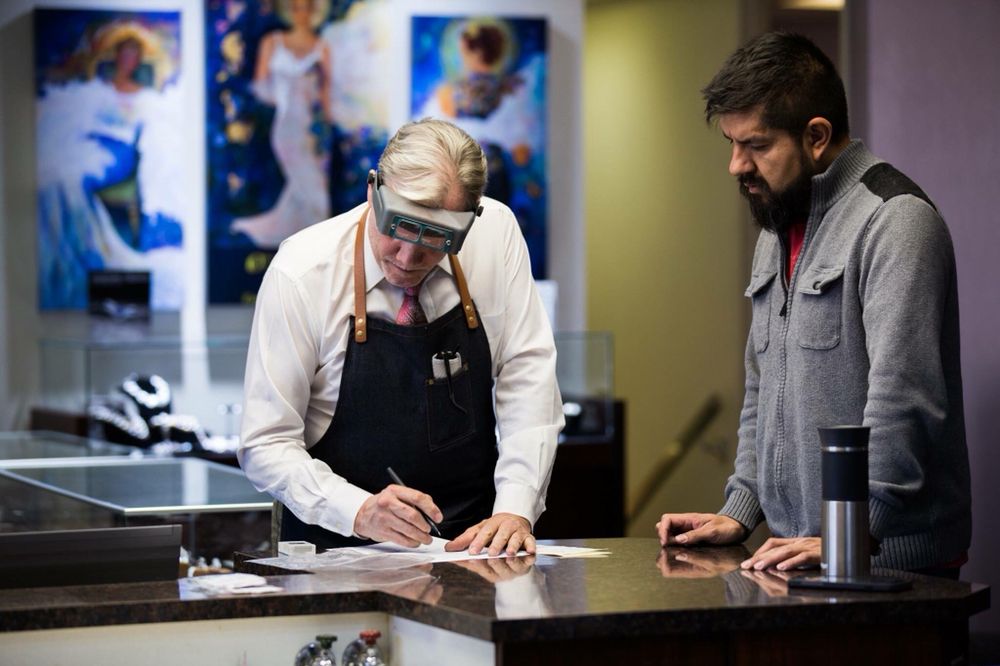
Behind the Scenes: A Day in the Life of a Custom Jewelry Designer
Before a custom piece becomes jewelry, it begins as a conversation, an idea, and sometimes little more than a feeling.
When you see a finished custom ring or pendant gleaming beneath the lights, it’s easy to focus on the obvious: the diamond, the gemstones, the polished gold or platinum.
What you don’t see are the hours of thought, decisions, measurements, adjustments, and craftsmanship that came before it.
At Lonnie’s Fine Jewelry, custom jewelry design is part artistry, part engineering, and part detective work. Every project presents a different puzzle to solve. One client may arrive with a detailed vision, while another simply knows they want something extraordinary.
So what actually happens behind the scenes?
It Usually Starts With a Story
The most important tool in custom jewelry design isn’t a pencil, computer, or jeweler’s bench.
It’s conversation.
A designer needs to understand why the piece is being created and who will wear it. Is it an engagement ring? An anniversary gift? A celebration of an achievement? Are we redesigning an heirloom that has been in the family for generations?
Clients often arrive with photographs, sketches, gemstones, or pieces of jewelry they’ve collected over the years. Others arrive with no visual references at all.
They might simply say, “I know what I don’t want.”
Believe it or not, that’s useful information too.
The designer’s job is to listen carefully and begin translating ideas, preferences, and personality into something that can eventually be made in precious metal.
Then Comes the Detective Work
Custom design often involves figuring out what someone loves about a piece without simply copying it.
Perhaps it’s the graceful shape of a vintage ring, but not the ornate detailing. Maybe it’s the setting of one design combined with the proportions of another. A client might love an emerald-cut center stone but want the overall ring to feel softer and less architectural.
This is where a custom jewelry designer begins separating inspiration from imitation.
The goal isn’t to reproduce someone else’s jewelry. It’s to understand what caught the client’s eye and use those elements as a starting point for an original design.
Choosing the Right Gemstones
For many custom pieces, the gemstones drive the design.
Selecting a diamond or colored gemstone involves much more than finding the appropriate carat weight. Shape, proportions, color, clarity, brilliance, and personality all matter.
Two diamonds with similar grading reports can look surprisingly different when viewed side by side.
Colored gemstones introduce even more variables. One sapphire may have a velvety royal blue, while another leans lighter or more violet. Emeralds, rubies, tourmalines, and other gemstones each have their own characteristics.
The designer also considers how the stone will interact with the finished piece. A beautiful gemstone deserves a setting that enhances it rather than competes with it.
From Idea to Design
Once the direction becomes clear, the concept begins taking physical form.
Depending on the project, this may involve sketches, precise measurements, and computer-aided design, commonly known as CAD.
CAD technology allows a custom jewelry designer to refine proportions, examine the piece from different angles, and determine exactly how gemstones and structural elements will work together before the jewelry is created.
Technology provides remarkable precision, but it doesn’t make the design decisions.
A computer can draw a ring.
It can’t decide whether that ring has grace.
That still requires an experienced human eye.
The Tiny Decisions That Make a Big Difference
Custom jewelry is filled with decisions most people will never consciously notice.
How high should the center stone sit?
How thick should the band be?
Should the prongs disappear visually or become part of the design?
How much space should exist between two gemstones?
Will the ring sit comfortably beside a wedding band?
Is the piece substantial enough for everyday wear without appearing heavy?
A fraction of a millimeter can affect both appearance and durability.
When those decisions are made well, the finished jewelry simply looks right. You may not be able to identify why, and that’s often the point.
Beauty Has to Survive Real Life
A custom jewelry designer can’t think only about appearance.
Jewelry has to be worn.
That means considering how a ring will withstand years of daily use, whether a pendant will hang properly, how a bracelet will move on the wrist, and whether gemstones are adequately protected.
A spectacular design that is uncomfortable or unnecessarily fragile isn’t successful custom jewelry.
Some of the most important work happens where no one sees it: beneath a gemstone, inside a setting, or along the back of a piece. Structural integrity is part of luxury craftsmanship, even when it’s invisible.
Then the Bench Takes Over
Once the design is finalized, the project moves from concept into craftsmanship.
The piece is created in the selected precious metal, and the finishing process begins. Depending on the design, this can involve casting, fabrication, stone setting, soldering, engraving, polishing, and numerous stages of hand finishing.
This is where tiny imperfections matter.
Prongs must be secure and balanced. Stones need to sit correctly. Surfaces must be finished beautifully. Details that appeared perfect in a rendering need to work equally well in metal.
The jeweler’s bench is where a digital design finally develops its physical personality.
And Sometimes Something Needs to Change
Custom design isn’t always a perfectly straight path from idea to finished piece.
Occasionally a proportion that looked right during planning needs refinement. A gemstone may inspire a slightly different approach once it’s being incorporated into the piece. A technical challenge may require a creative solution.
That’s part of custom craftsmanship.
The ability to recognize when something could be better, and to make the necessary adjustment, is one of the differences between simply producing jewelry and truly creating it.
The Final Inspection
Before a custom piece is ready for its owner, it deserves a careful final examination.
Gemstones are checked for security. Prongs, clasps, and other functional elements are inspected. The finish is examined from every angle. The piece is cleaned and polished until the metal and gemstones reveal what the designer envisioned from the beginning.
Only then comes the best part.
The Reveal
A photograph can’t quite capture the moment someone sees a custom piece for the first time.
Perhaps the new ring contains a grandmother’s diamond. Maybe it’s an engagement ring that has existed secretly for months. It might celebrate a major anniversary or represent a personal accomplishment no one else fully understands.
For the designer, that’s when all those tiny measurements, design revisions, gemstone decisions, and hours at the bench suddenly become something much bigger.
They become part of someone’s story.
More Than Making Jewelry
A day in the life of a custom jewelry designer isn’t simply about creating beautiful objects.
It’s about listening, interpreting, problem-solving, and understanding how artistry and engineering work together. It’s knowing when to embrace a client’s idea, when to suggest another direction, and when one tiny detail will transform a good design into an exceptional one.
At Lonnie’s Fine Jewelry, every custom piece begins differently because every client brings a different story to the design table.
And that’s exactly the way custom jewelry should be.
Have an idea you’ve been carrying around, an heirloom you’d love to transform, or simply a feeling for a piece you haven’t been able to find anywhere else? Contact Lonnie’s Fine Jewelry to begin a custom design conversation and discover what happens when your idea moves from imagination to the jeweler’s bench.